Clinical management of a Mesoamerican Rattlesnake (Crotalus simus) envenomation in Costa Rica
DOI:
https://doi.org/10.51481/amc.v68i1.1525Keywords:
antivenom, fasciotomy, snake bite, Crotalus, rattlesnake venom, snake venomAbstract
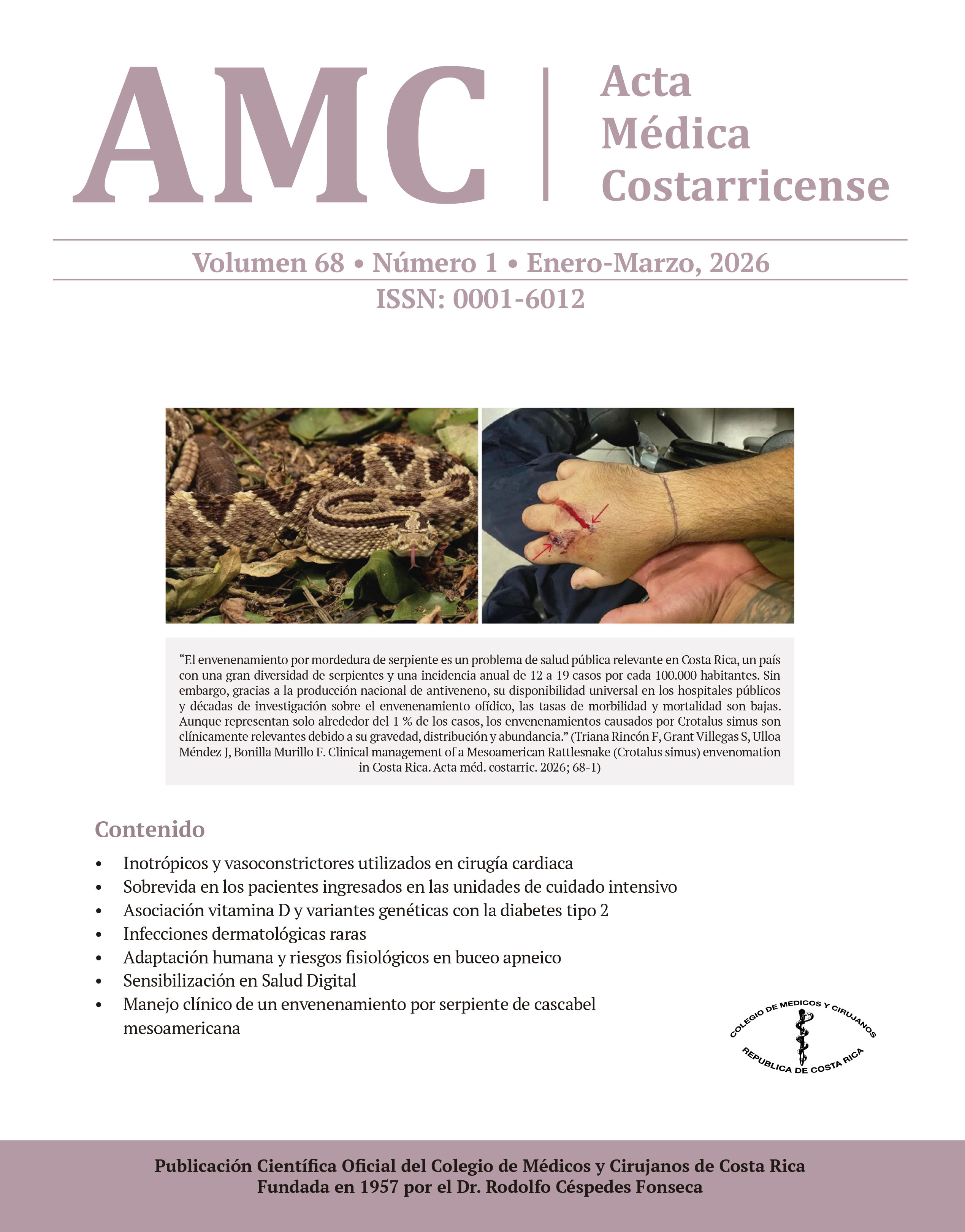
El accidente ofídico es un problema de salud pública relevante en Costa Rica, país que cuenta con una alta diversidad de serpientes y una incidencia anual de 12 a 19 casos/100,000 habitantes. Sin embargo, gracias a la producción nacional de suero antiofídico, su disponibilidad universal en hospitales públicos y décadas de investigación en envenenamientos por estos animales, las tasas de morbilidad y mortalidad son bajas. A pesar de representar aproximadamente el 1% de los casos en el país, los envenenamientos por Crotalus simus son clínicamente relevantes debido a su gravedad, la amplia distribución geográfica de la especie y la abundancia de especímenes. Presentamos un reporte de caso de un accidente ofídico causado por un adulto de C. simus (serpiente de cascabel mesoamericana) en el noroeste de Costa Rica. El paciente fue un hombre de 40 años, con un peso de 100 kg, quien fue mordido con ambos colmillos en la mano derecha. Posterior al evento, el paciente fue trasladado al Hospital de la Anexión de Nicoya, donde se le administraron 20 viales de suero antiofídico PoliVal-ICP. Entre los síntomas principales se reportaron dolor local, edema, eritema y parestesia. Adicionalmente, los exámenes de laboratorio revelaron alteraciones hematológicas y de la coagulación, consistentes con la composición del veneno de los adultos de esta especie, el cual es rico en metaloproteinasas. En el segundo día, el paciente fue trasladado al Hospital Calderón Guardia, un centro médico terciario con mayor capacidad resolutiva en la ciudad capital de San José, donde fue reevaluado debido a la persistencia del edema. Al tercer día, el equipo médico decidió realizar una fasciotomía e iniciar terapia antibiótica. En los días posteriores, el paciente fue sometido a lavados quirúrgicos y a la implementación de terapia de cierre asistido por vacío. Además, el paciente presentó enfermedad del suero al sexto día. El décimo día se retiró el sistema asistido por vacío y el paciente permaneció en observación hasta el día 14, cuando fue dado de alta. Finalmente, el paciente asistió luego a sesiones de terapia de rehabilitación para la recuperación de la funcionalidad motora. Este caso resalta la importancia del traslado hospitalario oportuno y la administración temprana del antiveneno como estrategias clave para reducir la mortalidad y la morbilidad asociadas al accidente ofídico. Sin embargo, también demuestra que es necesario fortalecer la vigilancia y la estandarización de los protocolos hospitalarios nacionales para prevenir intervenciones quirúrgicas innecesarias.
Downloads
References
1. Gutiérrez JM, Calvete JJ, Habib AG, Harrison RA, Williams DJ, Warrell DA. Snakebite envenoming. Nat. Rev. Dis. Primers. 2017; 3: 17063. DOI: 10.1038/nrdp.2017.63
2. Harrison RA, Hargreaves A, Wagstaff SC, Faragher B, Lalloo DG. Snake envenoming: a disease of poverty. PLoS Negl. Trop. Dis. 2009; 3: e569. DOI: 10.1371/journal.pntd.0000569
3. Kasturiratne A, Wickremasinghe AR, De Silva N, Gunawardena NK, Pathmeswaran A, Premaratna R, et al. The global burden of snakebite: a literature analysis and modelling based on regional estimates of envenoming and deaths. PLoS Med. 2008; 5: e218. DOI: 10.1371/journal.pmed.0050218
4. Hansson E, Sasa M, Mattisson K, Robles A, Gutiérrez JM. Using geographical information systems to identify populations in need of improved accessibility to antivenom treatment for snakebite envenoming in Costa Rica. PLoS Negl. Trop. Dis. 2013; 7: e2009. DOI: 10.1371/journal.pntd.0002009
5. Sasa M, Vázquez S. Snakebite envenomation in Costa Rica: a revision of incidence in the decade 1990–2000. Toxicon. 2003;41:19–22. DOI: 10.1016/s0041-0101(02)00172-1
6. Sasa M, Segura-Cano SE. New insights into snakebite epidemiology in Costa Rica: A retrospective evaluation of medical records. Toxicon X. 2020; 7: 100055. DOI: 10.1016/j.toxcx.2020.100055
7. Chippaux JP. Incidence and mortality due to snakebite in the Americas. PLoS Negl. Trop. Dis. 2017; 11: e0005662. DOI: 10.1371/journal.pntd.0005662
8. Fernández P, Gutiérrez JM. Mortality due to snakebite envenomation in Costa Rica (1993–2006). Toxicon. 2008; 52: 530-533. DOI: 10.1016/j.toxicon.2008.06.018
9. Gutiérrez JM. Snakebite poisoning in Latin America and the Caribbean: an integral view from a regional perspective. Bol. Mal. Salud Amb. 2011; 51: 1-16.
10. Bolaños R. Las serpientes venenosas de Centroamérica y el problema del ofidismo. Rev. Costarric. Cienc. Méd. 1982; 3: 165-184.
11. Calvete JJ, Sanz L, Cid P, De La Torre P, Flores-Díaz M, Dos Santos MC, et al. Snake venomics of the Central American rattlesnake Crotalus simus and the South American Crotalus durissus complex points to neurotoxicity as an adaptive paedomorphic trend along Crotalus dispersal in South America. J. Proteome Res. 2010; 9: 528–544. DOI: 10.1021/pr9008749
12. Lomonte B, Fernández J, Sanz L, Angulo Y, Sasa M, Gutiérrez JM, et al. Venomous snakes of Costa Rica: biological and medical implications of their venom proteomic profiles analyzed through the strategy of snake venomics. J. Proteomics. 2014; 105: 323–339. DOI: 10.1016/j.jprot.2014.02.020
13. Escalante T, Rucavado A, Fox JW, Gutiérrez JM. Key events in microvascular damage induced by snake venom hemorrhagic metalloproteinases. J. Proteomics. 2011; 74: 1781–1794. DOI: 10.1016/j.jprot.2011.03.026
14. Serrano SMT. The long road of research on snake venom serine proteinases. Toxicon. 2013; 62: 19–26. DOI: 10.1016/j.toxicon.2012.09.003
15. Boyer LV, Seifert SA, Clark RF, McNally JT, Williams SR, Nordt SP, et al. Recurrent and persistent coagulopathy following pit viper envenomation. Arch. Intern. Med. 1999; 159: 706-710. DOI: 10.1001/archinte.159.7.706
16. White J. Snake venoms and coagulopathy. Toxicon. 2005; 45: 951-967. DOI: 10.1016/j.toxicon.2005.02.030
17. Hardy DL, Jeter M, Corrigan, JJ. Envenomation by the northern blacktail rattlesnake (Crotalus molossus molossus): report of two cases and the vitro effects of the venom on fibrinolysis and platelet aggregation. Toxicon. 1982; 20: 487-493. DOI: 10.1016/0041-0101(82)90012-5
18. Zarzosa V, Lomonte B, Zamudio F, Ponce-López R, Olvera-Rodríguez F, Borja M, et al. Venom of the neotropical rattlesnake, Crotalus culminatus: Intraspecific variation, neutralization by antivenoms, and immunogenicity in rabbits. Biochimie. 2024; 216: 160-174. DOI: 10.1016/j.biochi.2023.10.014
19. Bucaretchi F, De Capitani EM, Branco MM, Fernandes LCR, Hyslop S. Coagulopathy as the main systemic manifestation after envenoming by a juvenile South American rattlesnake (Crotalus durissus terrificus): Case report. Clin. Toxicol. 2013; 51: 505–508. DOI: 10.3109/15563650.2013.802796
20. Budzynski AZ, Pandya BV, Rubin RN, Brizuela BS, Soszka T, Stewart GJ. Fibrinogenolytic afibrinogenemia after envenomation by western diamondback rattlesnake (Crotalus atrox). Blood. 1984; 63: 1-14. DOI: 10.1182/blood.V63.1.1.1
21. Bosak AR, Ruha AM, Graeme KA. A case of neurotoxicity following envenomation by the Sidewinder rattlesnake, Crotalus cerastes. J. Med. Toxicol. 2014; 10: 229-231. DOI: 10.1007/s13181-013-0373-0
22. Frare BT, Silva-Resende YK, Dornelas BC, Jorge MT, Souza-Ricarte VA, Alves LM, et al. Clinical, laboratory, and therapeutic aspects of Crotalus durissus (South American Rattlesnake) victims: A literature review. Biomed Res Int. 2019; 2019: 1345923. DOI: 10.1155/2019/1345923
23. Smelski G, Cardwell M, Larsen J. Neurotoxic respiratory failure absent following Arizona rattlesnake bites. Toxicon. 2023; 224: 107034. DOI: 10.1016/j.toxicon.2023.107034
24. Cañas CA. Is the acute compartment syndrome diagnosed in snake bites true?: A review. Medicine. 2024; 103: e40008. DOI: 10.1097/md.0000000000040008
25. Warrell DA, Williams DJ. Clinical aspects of snakebite envenoming and its treatment in low-resource settings. Lancet. 2023; 401: 1382-1398. DOI: 10.1016/S0140-6736(23)00002-8
26. Cumpston KL. Is there a role for fasciotomy in Crotalinae envenomations in North America?. Clin. Toxicol. 2011; 49: 351-365. DOI: 10.3109/15563650.2011.597032
27. Darracq MA, Cantrell FL, Klauk B, Thornton SL. A chance to cut is not always a chance to cure-fasciotomy in the treatment of rattlesnake envenomation: a retrospective poison center study. Toxicon. 2015; 101: 23-26. DOI: 10.1016/j.toxicon.2015.04.014
28. Banda CH, N’gambi C. Necrotizing fasciitis with mediastinitis following snakebite envenomation. SAGE Open Med. Case Rep. 2019; 7: 2050313X18823090. DOI: 10.1177/2050313X18823090
29. Yuenyongviwat V, Laohawiriyakamol T, Suwanno P, Kanjanapradit K, Tanutit P. Calcific myonecrosis following snake bite: a case report and review of the literature. J. Med. Case Rep. 2014; 8: 193. DOI: 10.1186/1752-1947-8-193
30. Alfaro-Chinchilla A, Segura A, Gómez A, Díaz C, Corrales G, Chacón D, et al. Expanding the neutralization scope of the Central American antivenom (PoliVal-ICP) to include the venom of Crotalus durissus pifanorum. J. Proteomics. 2021; 246: 104315. DOI: 10.1016/j.jprot.2021.10431
Downloads
Published
Issue
Section
License
Copyright (c) 2026 Acta Médica Costarricense

This work is licensed under a Creative Commons Attribution-NonCommercial-ShareAlike 4.0 International License.
Los autores que publican en la revista Acta Médica Costarricense pueden distribuir, copiar, remezclar, retocar, leer, descargar, imprimir, buscar y crear a partir de su obra de modo no comercial, indicando los créditos a la revista y sus autores y compartir su obra en las mismas condiciones. Para ello se aplica la licencia Creative Commons Reconocimiento-NoComercial-CompartirIgual 4.0 Internacional(CC BY-NC-SA 4.0)