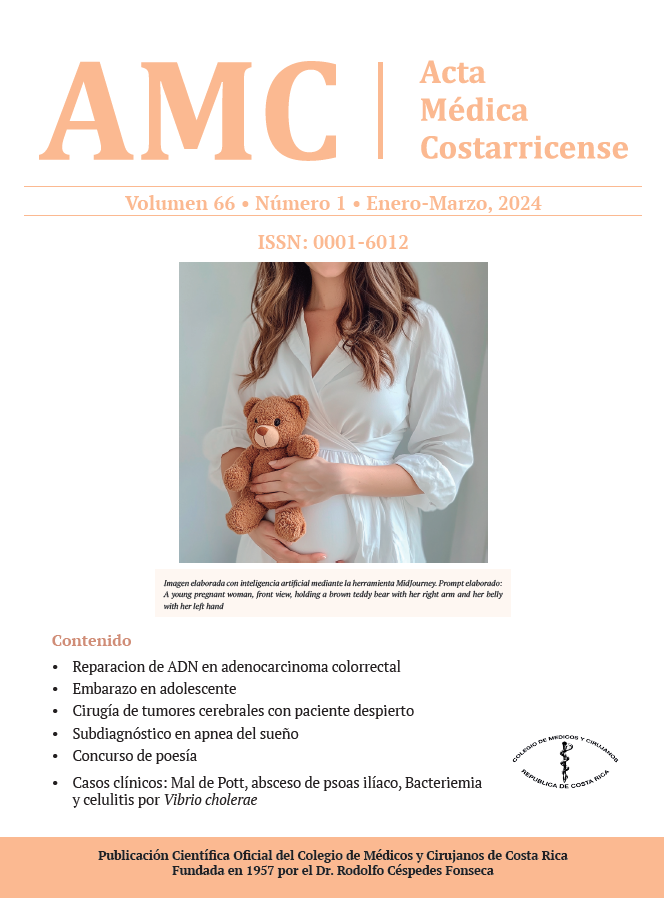
Características sociodemográficas y obstétricas de adolescentes embarazadas que asisten a control prenatal en los equipos básicos de atención integral en salud en una comunidad urbana y otra rural de Costa Rica
DOI:
https://doi.org/10.51481/amc.v66i1.1380Palabras clave:
Adolescencia, embarazo, atención prenatal, características sociodemográficasResumen
Objetivo: describir las características sociodemográficas y obstétricas de un grupo de adolescentes embarazadas que asisten a control prenatal en los Equipos Básicos de Atención Integral en Salud en un comunidad urbana y rural de Costa Rica.
Métodos: se realizó un estudio cualitativo de tipo descriptivo transversal en una comunidad rural (Golfito) y urbana (Alajuelita) de Costa Rica. La población del estudio estuvo conformada por todas las adolescentes embarazadas que cumplieran con los siguientes criterios de inclusión: tener menos de 20 años, asistir a control prenatal en los EBAIS de las comunidades en estudio y firmar el asentimiento o consentimiento informado. Para la recolección de la información se visitó a cada adolescente embarazada en su residencia, se realizó una entrevista y se completó el instrumento de recolección de datos elaborado para este fin. La información fue introducida en una base de datos elaborada en el programa Excel 2007 de Microsoft Office®, mismo que se utilizó para realizar una estadística descriptiva.
Resultados: participaron un total de 56 adolescentes embarazadas (14 en la zona rural y 42 en la zona urbana), con una edad promedio de 17 ± 1,5 años, en su mayoría son costarricenses, solteras, no han completado sus estudios secundarios y se dedican a las actividades domésticas. El 26,8% de las adolescentes presentaban embarazos previos, en promedio iniciaron control prenatal a las 10,9 ± 5,6 semanas de gestación y la mayoría (73,2%) inició el control durante el primer trimestre de embarazo.
Conclusiones: los resultados de este estudio ofrecen una aproximación de los aspectos sociodemográficos y obstétricos de adolescentes embarazadas que asisten a control prenatal en comunidades rural y urbana en Costa Rica, esto evidencia que la mayoría inició su control prenatal en el primer trimestre de embarazo, hecho que permitió recibir una atención en salud orientada a la promoción de la salud y prevención de enfermedades.
Descargas
Referencias
Loredo-Abdalá A, Vargas-Campuzano E., Casas-Muñoz A., González-Corona J., Gutiérrez-Leyva CJ. Embarazo adolescente: sus causas y repercusiones en la diada. Rev Med Inst Mex Seguro Soc. 2017; 55:223-229.
Martínez E., Montero G., Zambrano RM. El embarazo adolescente como un problema de salud pública en Latinoamérica. Revista Espacios. 2020;41(47):1-10. DOI:10.48082/espacios-a20v41n47p01
Flores-Valencia ME., Nava-Chapa G., Arenas-Monreal L. Embarazo en la adolescencia en una región de México: un problema de Salud Pública. Rev. Salud pública. 2017; 19: 374-378. DOI:10.15446/rsap.v19n3.43903
Área Censos y Encuestas. Instituto Nacional de Estadística y Censos. Encuesta de Hogares de Propósitos Múltiples julio 2009. San José: INEC, 2009.
Poo A., Baeza B., Capel P., Llano M., Tuma D., Zúñiga D. Factores que favorecen la generación del embarazo en la adolescencia desde la perspectiva de adolescentes primigestas en control prenatal. Rev Sogia. 2005;12: 17-24.
Ahorlu CK., Pfeiffer C., Obrist B. Socio-cultural and economic factors influencing adolescents’ resilience against the threat of teenage pregnancy: a cross-sectional survey in Accra, Ghana. Reprod Health. 2015;12. DOI:10.1186/s12978-015-0113-9
Niño B, Ortiz SP., Solano S., Amaya CM., Serrano L. Concepciones del embarazo en adolescentes gestantes de la ciudad de Bucaramanga. Rev Cuid. 2017;8: 1875-1886. DOI: 10.15649/cuidarte.v8i3.448.
Villalobos-Hernández A., Campero L., Suárez-López L., Atienzo EE., Estrada F., de la Vara-Salazar D. Embarazo adolescente y rezago educativo: análisis de una encuesta nacional en México. Salud pública de Mex. 2015; 57: 135-143.
Mendoza Tascón LA., Claros Benítez DI., Peñaranda Ospina CB. Actividad sexual temprana y embarazo en la adolescencia: estado del arte. Rev. chil. obstet ginecol. 2016;81: 243-253. DOI: 10.4067/S0717-75262016000300012.
Vikram K, Vanneman R. Maternal education and the multidimensionality of child health outcomes in India. J Biosoc Sci. 2020;52:57-77. doi:10.1017/S0021932019000245
Ruiz AMB., García MY. Factores asociados a la no adherencia del control prenatal en gestantes. Revista Arbitrada Interdisciplinaria de Ciencias de la Salud. Salud y Vida.2020; 4: 74-96. DOI: 10.35381/s.v.v4i7.646
Castillo Ávila IY., Fortich Acuña LM., Padilla Yánez J., Monroy Gascón MA., Morales Pérez Y., Ahumada Tejera AM. Factores asociados al uso adecuado del control prenatal en 13 municipios de Bolívar, Colombia. Rev Cubana Enfermer. 2017; 33: 62-71.
Zavala-García A., Ortiz-Reyes H., Salomon-Kuri J, Padilla-Amigo C, Preciado Ruiz R. “Periodo intergenésico: Revisión de la literatura”. Rev. chil. obstet. ginecol. 2018; 83:52-61. DOI: 10.4067/s0717-75262018000100052
Wilcamango S., Pinto N., Flores Lovon K., Ticona D., Gutiérrez EL. Características clínico-epidemiológicas de adolescentes multíparas atendidas en el Instituto Nacional Materno Perinatal de Lima, Perú. Rev. cient. cienc. salud. 2023; 5:e5119. DOI: 10.53732/rccsalud/2023.e5119
Mendoza Tascón LA., Arias Guatibonza MD., Peñaranda Ospina CB.; Mendoza Tascón LI., Manzano Penagos S., Varela Bahena AM. Influencia de la adolescencia y su entorno en la adherencia al control prenatal e impacto sobre la prematuridad, bajo peso al nacer y mortalidad neonatal. Rev. chil. obstet. ginecol. 2015;80:306-315. http://dx.doi.org/10.4067/S0717-75262015000400005.
Cruz Naranjo MC., Lastra Lamby NI., Expósito Concepción MY. Estados afectivos de adolescentes gestantes al asistir al control prenatal en una institución de primer nivel de atención. Rev Cubana Med Gen Integr. 2022;38: e1579.
Descargas
Publicado
Número
Sección
Licencia
Derechos de autor 2024 Acta Médica Costarricense

Esta obra está bajo una licencia internacional Creative Commons Atribución-NoComercial-CompartirIgual 4.0.
Los autores que publican en la revista Acta Médica Costarricense pueden distribuir, copiar, remezclar, retocar, leer, descargar, imprimir, buscar y crear a partir de su obra de modo no comercial, indicando los créditos a la revista y sus autores y compartir su obra en las mismas condiciones. Para ello se aplica la licencia Creative Commons Reconocimiento-NoComercial-CompartirIgual 4.0 Internacional(CC BY-NC-SA 4.0)