Study Population
Subjects were recruited prospectively between November 2008 and June 2010 and entered in the cohort at the time of presentation with zoster rash or ZAP symptoms.
Incident cases were defined as subjects recruited at the investigator’s office for a current zoster episode which had a duration of equal or less than 7 days. Prevalent cases were defined as patients enrolled while visiting the investigator for a current zoster episode which lasted longer than 7 days and for which the onset of rash had been recorded in the medical records. The onset of disease was defined by the zoster rash onset date rather than the date of cohort entry.
Patients who fulfilled all inclusion criteria and consented were eligible for study entry. Patients were required to be at least 50 years of age at the onset date of zoster rash and had a physicianconfirmed diagnosis of zoster rash or ZAP including acute pain or PHN. The date of onset was required to be documented in the patient’s chart. Patients were further expected to be capable of completing the study questionnaires, understanding the study and the content of the consent form, were in agreement to participate in the study by signing the informed consent and were available for the study follow-up period.
| Table 1. Sociodemographics | |
| Parameter | Total Number of Patients (N=50) |
| Gender, n (%) Male Female Age Mean (SD) 50-54, n (%) 55-64, n (%) 65-74, n (%) 75-84, n (%) ≥85, n (%) Highest Level of Education, n (%) Primary/ Grade School Secondary/ Equivalent Technical or Community College University Current Employment Status, n (%) Full-Time Retired Unemployed Home Maker Other | 16 (32.0) 34 (68.0) 69.5 (10.8) 5 (10.0) 12 (24.0) 15 (30.0) 14 (28.0) 4 (8.0) 29 (58.0) 13 (26.0) 6 (12.0) 2 (4.0) 7 (14.0) 32 (64.0) 5 (10.0) 5 (10.0) 1 (2.0) |
| SD=standard deviation | |
Study Schedule
Following the baseline assessment (day 0) conducted at the investigator’s office, nine assessments were conducted with the aid of self-administered questionnaires at days 7, 14, 21, 30, 60, 90, 120, 150 and 180 following the subjects’ cohort entry. Scheduled visits occurred at days 14, 30 and 180. All patients were followed for six months under the same schedule regardless of the phase of the disease at the time of enrollment.
Data was collected using case report forms (CRFs) and questionnaires. CRFs were completed at the physician’s office during the baseline visit. Questionnaires were completed by the patients and returned to the study physician or coordinator to be subsequently mailed to the data management and analysis centre in Canada.
Outcome Measures
The primary outcome assessed the burden of illness due to ZAP from HZ rash onset as measured by the Zoster Brief Pain Inventory (ZBPI) and the Initial Zoster Impact Questionnaire (IZIQ), the latter representing an extension of the ZBPI to assess prodromal pain.24 Impact of zoster and/or ZAP on QoL were measured with the Euro-QoL (EQ-5D) index 25 using Latin American weights 26. The EQ-5D was administered on two occasions to capture the patient’s usual QoL without zoster, ZAP or PHN as well as the QoL in his/her current health state.
Patient-reported HCRU was assessed via a simple questionnaire that was administered at each follow-up visit. The questionnaire was used to record the visits to physicians or clinics, hospitalizations, use of other health related services including physiotherapy, nursing services, psychologists, rehabilitation, natural or alternative medicine, prescription medications, over the counter medications as well as diagnostic tests and procedures performed for the current episode.
Statistical Analysis
Descriptive statistics were produced for all variables of the study. Measures of central tendency (mean) and dispersion (standard deviation – SD) were produced for all continuous scale variables and frequency distributions for all categorical scale variables. The change in QoL over time from baseline after HZ rash appeared was assessed for statistical significance with the paired-samples t-test.
All statistical analyses were performed using the Statistical Package for Social Sciences (SPSS Inc., version 21, Chicago, IL, USA).
Results
Table 1 presents the sample’s baseline characteristics including socio-demographics. A total of 50 patients were
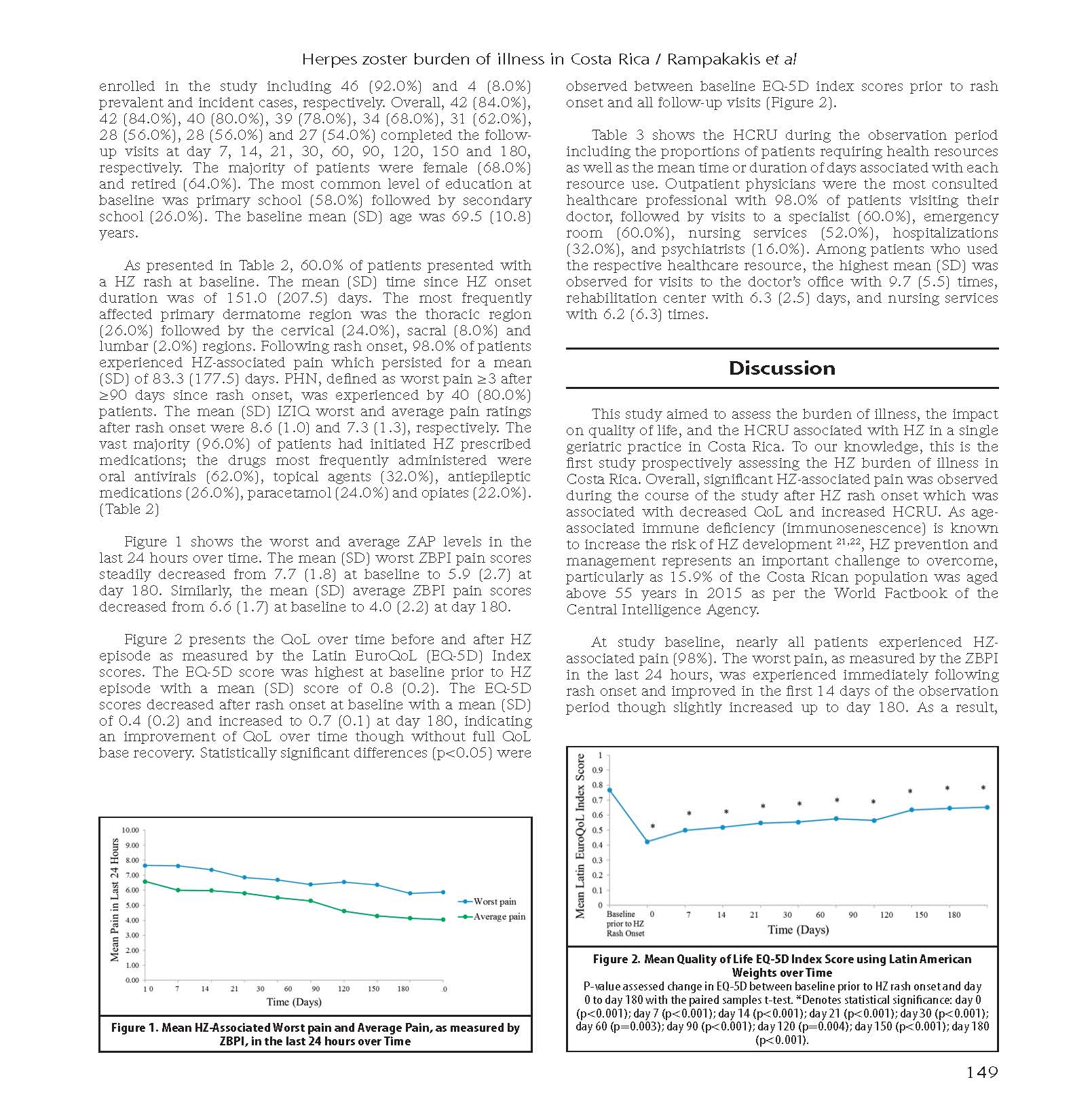
EQ-5D scores indicated an initial worsening of QoL following period, EQ-5D levels did not return to pre-HZ episode values rash onset followed by a gradual improvement up to day 180. at day 180. Statistically significant differences (p<0.05) were Despite a slight amelioration of QoL during the observation observed between pre-HZ rash EQ-5D index scores and all
| Table 2. Baseline Disease Characteristics | |
| Parameter | Total Number of Patients (N=50) |
| HZ Rash Present at Baseline, n (%) Time Since HZ Onset from Cohort Entry, days, mean (SD) Primary Dermatome Region Affected, n (%) Cervical Lumbar Sacral Thoracic Not Applicable Number of Lesions in the Primary and Adjacent Dermatomes, n (%) None 1-10 11-20 21-50 Missing Not Applicable HZ-Associated Pain, n (%) Pain Following HZ Rash Onset Pain or Painful Abnormal Sensation, n (%) Number of Days with Pain from HZ Rash Onset, mean (SD) Worst Pain Rating, mean (SD)1 Average Pain Rating, mean (SD)1 HZ Treatment, n (%)2 Any Type Antiviral Aciclovir Valaciclovir Famciclovir Topical Agent3 Antiepileptic Paracetamol Opiates Steroids NSAID or Aspirin Anxiolytics Antidepressants | 30 (60.0) 151.0 (207.5) 12 (24.0) 1 (2.0) 4 (8.0) 13 (26.0) 20 (40.0) 2 (4.0) 7 (14.0) 13 (26.0) 7 (14.0) 1 (2.0) 20 (40.0) 49 (98.0) 49 (98.0) 83.3 (177.5) 8.6 (1.0) 7.3 (1.3) 48 (96.0) 31 (62.0) 27 (54.0) 4 (8.0) 2 (4.0) 16 (32.0) 13 (26.0) 12 (24.0) 11 (22.0) 9 (18.0) 7 (14.0) 3 (6.0) 3 (6.0) |
| 1 Measured with the Initial Zoster Impact Questionnaire. Pain score: 0, no pain; 10, worst pain 2 Each patient was counted once per medication type 3 Including antiviral, antibiotic and steroids SD=standard deviation | |