other variables (age, gender, comorbidities, among others) were included, which were used to adjust the model estimation, and the decision to include or exclude them was made according to the criteria for variable selection.
Once an adequate model was obtained, odd ratios were calculated for the outcome categories considered least healthy (i.e., prefrail and frail). This was because the outcome category considered healthy (robust) was the one used as reference. With these odd ratios, the respective 95% confidence intervals were estimated, mainly focusing on the relationship between outcome and frailty.
| Table 1. Costa Rica: Prevalence of health and sociodemographic characteristics of the elderly of analyzed on the year 2005* |
|---|
| Health and sociodemographic characteristics Percentual distribution |
|---|
| Age 60 -69 53,8 70 -79 31,6 80+ 14,7 Sex Female 52,5 Male 47,5 Education ≤ 6to 78,5 7mo-9no 7,7 ≥ 10mo 13,8 **Income ≤ 100 US dollars 41,9 100-520 US dollars 38,1 ≥ 520 US dollars 20,0 Physical activity Yes 31,4 No 68,6 Live alone Yes 9,9 No 90,1 Health self-perception Healthy 52,7 Unhealthy 47,3 |
|---|
| Note: The total analyzed population was 2827. *Base year. **1 US dollars approx 480 colones. (2005) Abbreviation: US, United State Dollars. |
|---|
To carry out the analysis, all the available cases of the CRELES study database which belong to the cohort that follows in the period 2005-2009 were used. In the year of the initial cohort (2005), there was a total of 2827 patients, and counting for the final year of the cohort with 1863 patients. There are no analytical exclusion criteria because they point in the same direction as those already carried out by the CRELES study, where 525 cases were lost due to mortality and 439 because they could not be contacted to follow them.
Results
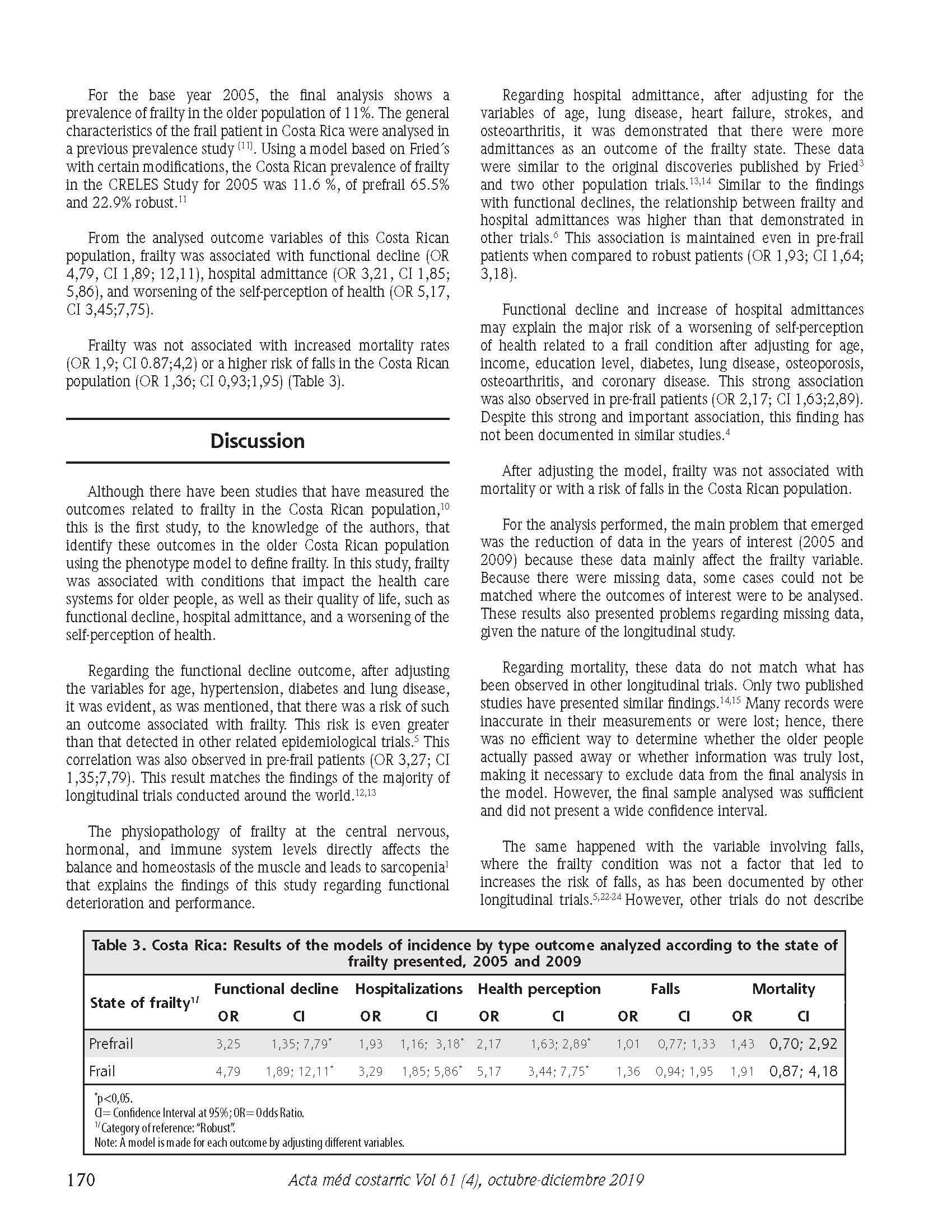
The final sample of the base year 2005 was composed of 2827 individuals with ages ranging from 60 to 109 (average of 70 years). 52,5% were women. The sociodemographic and health characteristics of the analysed patients are summarized in tables 1 and 2. 53.8% were under the age of 69 years, 31.6% between the ages of 70 to 79 years and 14.7% presented ages from 80 or above. The education level of the study population was low, for this study 78.5% presented an education level of less than 6 years of schooling. At the economic level, 41.9% presented an income of less than 100 United State Dollars (USD) and an 20% presented data of more than 520 USD per month. 9.9% of the analysed patients lived by themselves and a 47,3% presented a poor health perception.
Regarding comorbidities seen in the frail patients, 48,4% has hypertension, 20.8% Diabetes, 16,7% pulmonary illness, 9.7% osteoporosis, 14.6% arthritis, 3.8% with cerebrovascular events, 5.9% cancer, 4.6% coronary disease and 39.6% had dyslipidaemia (table 2).
| Table 2. Costa Rica: Prevalence of comorbidities of analyzed elderly on the year 2005* |
|---|
| Variable Percentage (%) |
|---|
| Arthritis 14,6 Falls 46,0 Cerebrovascular event 3,8 Osteoporosis 9,7 Hypertension 48,4 Diabetes 20,8 Cancer 5,9 Pulmonary Disease 16,7 Heart attack 4,6 Cholesterol 39,6 Smoking 43,1 |
|---|
| Note: The total analyzed population was 2827. *Base year. |
|---|